Dive Log
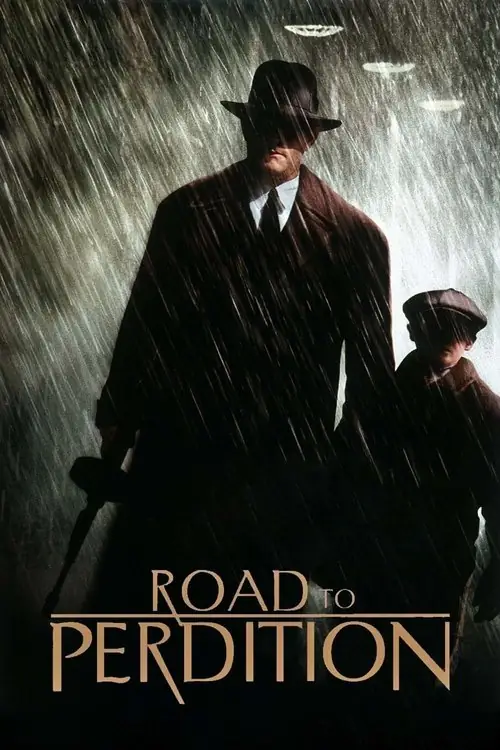
This Depression-era crime drama constructs a melancholic architecture of paternal devotion and professional violence, centering on an enforcer whose vocational identity exists in permanent tension with his familial one. The protagonist serves a patriarchal crime lord whose affection has assumed the contours of fatherhood, creating a triangular emotional geometry—the surrogate father, the biological son, the adopted weapon—that the filmmaker explores with the moral seriousness of tragedy rather than the kineticism of genre. The catalytic catastrophe arrives when the enforcer's offspring witnesses a professional killing, an event that ruptures the compartmentalization upon which the protagonist's dual existence depends. The directorial approach draws consciously from the visual vocabulary of Depression-era photography, the cinematographer's lens rendering the Midwestern landscape with the tonal gravity of Dorothea Lange or Walker Evans. Rain recurs with near-mythic frequency, the precipitation functioning as both atmospheric texture and moral commentary—a world perpetually undergoing a baptism insufficient to achieve absolution. The framing recurrently positions characters within architectural geometries that emphasize their entrapment, the clean lines of period architecture becoming the bars of cages whose construction predates the characters' arrival. The score, dominated by piano motifs of aching restraint, refuses the propulsive rhythms typical of the genre. The performances achieve a remarkable depth of internalization, the lead actor communicating volumes through the particular quality of his stillness, through the weight of his silence. The relationship between father and son—foregrounded once the narrative shifts into its picaresque phase of flight and pursuit—accumulates emotional density through gesture and glance rather than exposition. The antagonist, a photographer-assassin whose hobby of capturing death's image provides the film's most potent metaphoric apparatus, embodies the coldness of professional violence with a creep-ifying specificity. What the work ultimately anatomizes is the impossibility of moral inheritance—the recognition that a father's sins, however lovingly intended to shield his offspring, transmit themselves through the very act of concealment, and that the road toward whatever redemption remains available to damaged men runs directly through the acknowledgment of damage done.
This Depression-era crime drama constructs a melancholic architecture of paternal devotion and professional violence, centering on an enforcer whose vocational identity exists in permanent tension with his familial one. The protagonist serves a patriarchal crime lord whose affection has assumed the contours of fatherhood, creating a triangular emotional geometry—the surrogate father, the biological son, the adopted weapon—that the filmmaker explores with the moral seriousness of tragedy rather than the kineticism of genre. The catalytic catastrophe arrives when the enforcer's offspring witnesses a professional killing, an event that ruptures the compartmentalization upon which the protagonist's dual existence depends. The directorial approach draws consciously from the visual vocabulary of Depression-era photography, the cinematographer's lens rendering the Midwestern landscape with the tonal gravity of Dorothea Lange or Walker Evans. Rain recurs with near-mythic frequency, the precipitation functioning as both atmospheric texture and moral commentary—a world perpetually undergoing a baptism insufficient to achieve absolution. The framing recurrently positions characters within architectural geometries that emphasize their entrapment, the clean lines of period architecture becoming the bars of cages whose construction predates the characters' arrival. The score, dominated by piano motifs of aching restraint, refuses the propulsive rhythms typical of the genre. The performances achieve a remarkable depth of internalization, the lead actor communicating volumes through the particular quality of his stillness, through the weight of his silence. The relationship between father and son—foregrounded once the narrative shifts into its picaresque phase of flight and pursuit—accumulates emotional density through gesture and glance rather than exposition. The antagonist, a photographer-assassin whose hobby of capturing death's image provides the film's most potent metaphoric apparatus, embodies the coldness of professional violence with a creep-ifying specificity. What the work ultimately anatomizes is the impossibility of moral inheritance—the recognition that a father's sins, however lovingly intended to shield his offspring, transmit themselves through the very act of concealment, and that the road toward whatever redemption remains available to damaged men runs directly through the acknowledgment of damage done.
— Diver's log, recovered 1941, pressure index 47