Dive Log
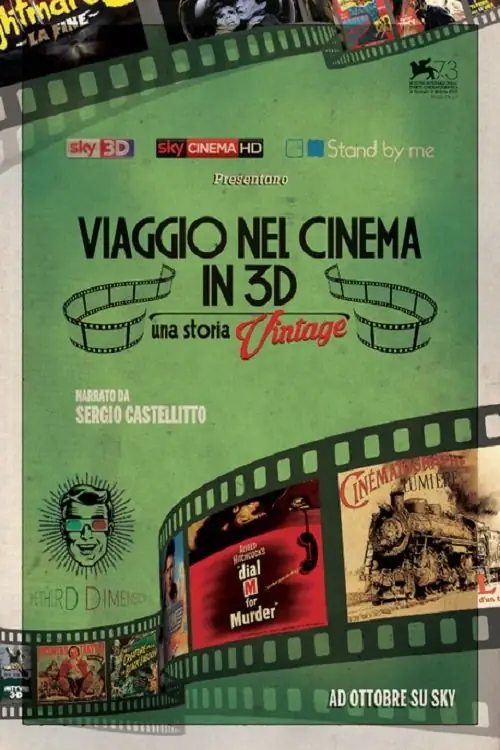
A narrated cinematic essay that traces the lineage of stereoscopic filmmaking from the very inception of the motion picture medium, revealing that the desire to collapse the distance between image and viewer has haunted the cinema since its earliest flickerings. The narration guides the spectator through an archaeological excavation of three-dimensional technique, beginning with the embryonic experiments of the Lumière brothers, whose arrival of a train at a station already suggested the terrifying proximity that depth could confer upon the projected image, and proceeding through the golden age of 1950s stereoscopy, when filmmakers grasped that the illusion of volume could function as both commercial spectacle and artistic instrument. The documentary demonstrates that the technology of depth has never been a mere ancillary enhancement but rather a recurring obsession that resurfaces whenever the flatness of the screen threatens to reduce cinema to passive observation. The selections from mid-century productions, including a master of suspense's experiment with dimensional storytelling and the creature features that weaponized protrusion as a register of horror, reveal how directors adapted their visual grammar to exploit the unique properties of the stereoscopic field. Objects thrust toward the audience became instruments of engagement, forcing the spectator into a relationship with the image that brooked no comfortable distance. What the film ultimately argues is that the persistent return to three-dimensional technology represents something more fundamental than commercial opportunism: it betrays the cinema's irrepressible aspiration toward totality, toward an experience that transcends the proscenium and envelops the viewer in a spatial reality indistinguishable from lived perception. Each technological iteration, from the anaglyphic experiments of the early twentieth century through the polarized systems of the postwar boom, represents a new attempt to solve the same essential problem: how to make the represented world possess the density and occupation of space that the actual world claims as its exclusive property. The documentary's vintage approach, treating its archival materials with the reverence ordinarily reserved for archaeological artifacts, underscores the continuity of this ambition across more than a century of technical evolution, suggesting that the quest for dimensional plenitude is not a peripheral curiosity but one of the medium's defining aspirations.
A narrated cinematic essay that traces the lineage of stereoscopic filmmaking from the very inception of the motion picture medium, revealing that the desire to collapse the distance between image and viewer has haunted the cinema since its earliest flickerings. The narration guides the spectator through an archaeological excavation of three-dimensional technique, beginning with the embryonic experiments of the Lumière brothers, whose arrival of a train at a station already suggested the terrifying proximity that depth could confer upon the projected image, and proceeding through the golden age of 1950s stereoscopy, when filmmakers grasped that the illusion of volume could function as both commercial spectacle and artistic instrument. The documentary demonstrates that the technology of depth has never been a mere ancillary enhancement but rather a recurring obsession that resurfaces whenever the flatness of the screen threatens to reduce cinema to passive observation. The selections from mid-century productions, including a master of suspense's experiment with dimensional storytelling and the creature features that weaponized protrusion as a register of horror, reveal how directors adapted their visual grammar to exploit the unique properties of the stereoscopic field. Objects thrust toward the audience became instruments of engagement, forcing the spectator into a relationship with the image that brooked no comfortable distance. What the film ultimately argues is that the persistent return to three-dimensional technology represents something more fundamental than commercial opportunism: it betrays the cinema's irrepressible aspiration toward totality, toward an experience that transcends the proscenium and envelops the viewer in a spatial reality indistinguishable from lived perception. Each technological iteration, from the anaglyphic experiments of the early twentieth century through the polarized systems of the postwar boom, represents a new attempt to solve the same essential problem: how to make the represented world possess the density and occupation of space that the actual world claims as its exclusive property. The documentary's vintage approach, treating its archival materials with the reverence ordinarily reserved for archaeological artifacts, underscores the continuity of this ambition across more than a century of technical evolution, suggesting that the quest for dimensional plenitude is not a peripheral curiosity but one of the medium's defining aspirations.
— Diver's log, recovered 1960, pressure index 51