Dive Log
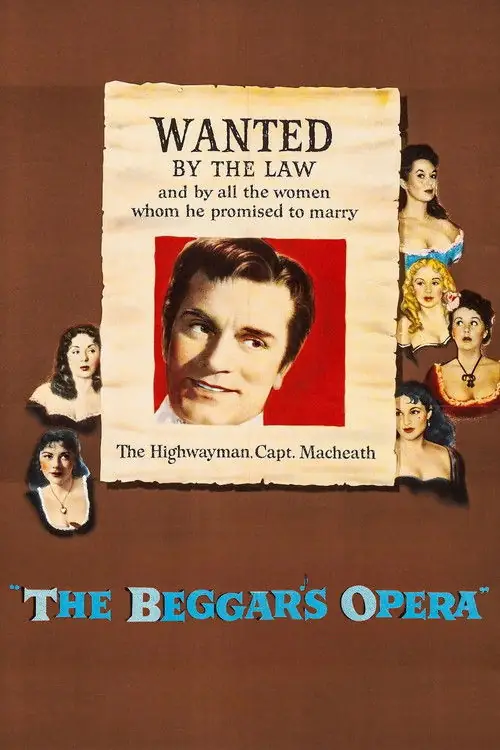
Resurrecting one of the English stage's most incendiary satirical works for the screen, this adaptation transposes John Gay's eighteenth-century ballad opera — a work that scandalized Georgian society by wedding beggar's cant to Italianate melody — into a cinematic register that preserves the source material's radical egalitarian spirit while exploiting the particular resources of the film medium. The central performance, delivered by one of the twentieth century's most commanding stage actors, captures the roguish charisma of the highwayman protagonist with a theatricality that the camera both amplifies and subtly undermines: close-ups reveal the calculations behind the charm, the quicksilver intelligence that assesses every social interaction as an opportunity for exploitation or survival. Opposite him, the actor portraying the titular beggar-narrator functions as both chorus and critique, his commentary framing the action with an ironic distance that recalls Brechtian Verfremdungseffekt even as it remains faithful to Gay's original dramaturgical structure. The musical numbers — and this is fundamentally a work of music theater — are staged with an awareness that cinematic space permits choreographic possibilities unavailable on the proscenium stage: the camera joins the choreography, weaving among performers, inhabiting the rhythm of the score rather than merely observing it from a fixed position. Production design evokes the Hogarthian London of the original's moment — gin-soaked alleys, overcrowded tenements, the vertiginous social topography where thieves and statesmen conduct business according to identical principles of self-interest — but does so with a pictorial richness that transforms historical specificity into visual poetry. The satirical skeleton remains intact: the thesis that criminality and political authority operate by the same moral logic, differing only in the scale of their predation, gains renewed urgency in any era that witnesses the collusion of wealth and power. Supporting performances from the ensemble conjure an entire social ecology — whores, fences, jailers, politicians — each rendered with the particularity that transforms type into character. This is adaptation as act of cultural preservation and reinvention, rescuing a work whose radical implications have never ceased to resonate from the museum case of historical curiosity and restoring it to confrontational life.
Resurrecting one of the English stage's most incendiary satirical works for the screen, this adaptation transposes John Gay's eighteenth-century ballad opera — a work that scandalized Georgian society by wedding beggar's cant to Italianate melody — into a cinematic register that preserves the source material's radical egalitarian spirit while exploiting the particular resources of the film medium. The central performance, delivered by one of the twentieth century's most commanding stage actors, captures the roguish charisma of the highwayman protagonist with a theatricality that the camera both amplifies and subtly undermines: close-ups reveal the calculations behind the charm, the quicksilver intelligence that assesses every social interaction as an opportunity for exploitation or survival. Opposite him, the actor portraying the titular beggar-narrator functions as both chorus and critique, his commentary framing the action with an ironic distance that recalls Brechtian Verfremdungseffekt even as it remains faithful to Gay's original dramaturgical structure. The musical numbers — and this is fundamentally a work of music theater — are staged with an awareness that cinematic space permits choreographic possibilities unavailable on the proscenium stage: the camera joins the choreography, weaving among performers, inhabiting the rhythm of the score rather than merely observing it from a fixed position. Production design evokes the Hogarthian London of the original's moment — gin-soaked alleys, overcrowded tenements, the vertiginous social topography where thieves and statesmen conduct business according to identical principles of self-interest — but does so with a pictorial richness that transforms historical specificity into visual poetry. The satirical skeleton remains intact: the thesis that criminality and political authority operate by the same moral logic, differing only in the scale of their predation, gains renewed urgency in any era that witnesses the collusion of wealth and power. Supporting performances from the ensemble conjure an entire social ecology — whores, fences, jailers, politicians — each rendered with the particularity that transforms type into character. This is adaptation as act of cultural preservation and reinvention, rescuing a work whose radical implications have never ceased to resonate from the museum case of historical curiosity and restoring it to confrontational life.
— Diver's log, recovered 1968, pressure index 84