Dive Log
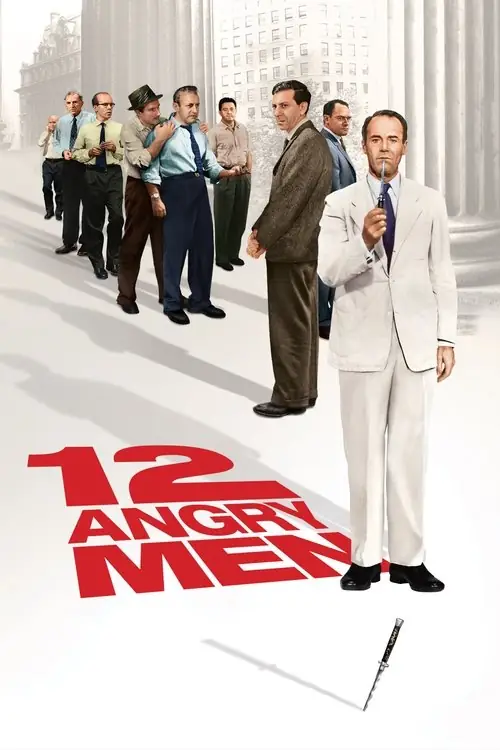
Confined to a single, airless chamber as the summer heat presses against the windows like an accusation, this formally radical courtroom drama achieves the impossible: it transforms deliberation into spectacle, abstraction into flesh, and civic duty into psychological bloodsport. The premise is deceptively austere — twelve men, one room, a verdict to deliver — yet from these minimal materials the director constructs an edifice of escalating tension that rivals the most elaborately staged thrillers. The accused exists only as absence, a spectral presence whose life hangs in the balance of conversations he cannot hear and reasoning he cannot challenge; this structural omission proves the film's most potent formal choice, forcing the audience to supply the defendant's humanity from the evidence of the jurors' own flawed, revealing discourse. Initial unanimity fractures under the weight of a single dissenting voice, and what follows is not merely a rehearsal of evidence but an excavation of the psychological substrata upon which certainty is built. Each juror carries into the room a private lexicon of bias, memory, fear, and rage, and the drama's genius lies in the patient, almost geological manner by which these sedimented attitudes are laid bare. Camera choreography operates with the precision of a string quartet: as the deliberation intensifies, the lens migrates from wide compositions that emphasize the room's oppressive dimensions to increasingly claustrophobic close-ups that trap the viewer against the sweating, desperate faces of men whose certainties are crumbling. The production design renders the jury room as a pressure vessel — the fan that refuses to turn, the rain that eventually breaks, the bathroom that offers the only temporary escape — each environmental detail accruing symbolic weight without succumbing to obviousness. Performances achieve an ensemble chemistry that feels almost thermodynamic, the interpersonal dynamics shifting like weather systems as alliances form, dissolve, and reform. The screenplay's structural architecture mirrors the legal process itself: evidence is revisited, testimony reinterpreted, reasonable doubt assembled brick by patient brick until what seemed monolithic reveals itself as riddled with fissures. The final frames offer no triumph — only the quiet, unsettling recognition that justice, when it functions at all, does so not through inspiration but through the exhausting, imperfect labor of mutual accountability.
Confined to a single, airless chamber as the summer heat presses against the windows like an accusation, this formally radical courtroom drama achieves the impossible: it transforms deliberation into spectacle, abstraction into flesh, and civic duty into psychological bloodsport. The premise is deceptively austere — twelve men, one room, a verdict to deliver — yet from these minimal materials the director constructs an edifice of escalating tension that rivals the most elaborately staged thrillers. The accused exists only as absence, a spectral presence whose life hangs in the balance of conversations he cannot hear and reasoning he cannot challenge; this structural omission proves the film's most potent formal choice, forcing the audience to supply the defendant's humanity from the evidence of the jurors' own flawed, revealing discourse. Initial unanimity fractures under the weight of a single dissenting voice, and what follows is not merely a rehearsal of evidence but an excavation of the psychological substrata upon which certainty is built. Each juror carries into the room a private lexicon of bias, memory, fear, and rage, and the drama's genius lies in the patient, almost geological manner by which these sedimented attitudes are laid bare. Camera choreography operates with the precision of a string quartet: as the deliberation intensifies, the lens migrates from wide compositions that emphasize the room's oppressive dimensions to increasingly claustrophobic close-ups that trap the viewer against the sweating, desperate faces of men whose certainties are crumbling. The production design renders the jury room as a pressure vessel — the fan that refuses to turn, the rain that eventually breaks, the bathroom that offers the only temporary escape — each environmental detail accruing symbolic weight without succumbing to obviousness. Performances achieve an ensemble chemistry that feels almost thermodynamic, the interpersonal dynamics shifting like weather systems as alliances form, dissolve, and reform. The screenplay's structural architecture mirrors the legal process itself: evidence is revisited, testimony reinterpreted, reasonable doubt assembled brick by patient brick until what seemed monolithic reveals itself as riddled with fissures. The final frames offer no triumph — only the quiet, unsettling recognition that justice, when it functions at all, does so not through inspiration but through the exhausting, imperfect labor of mutual accountability.
— Diver's log, recovered 1971, pressure index 96